
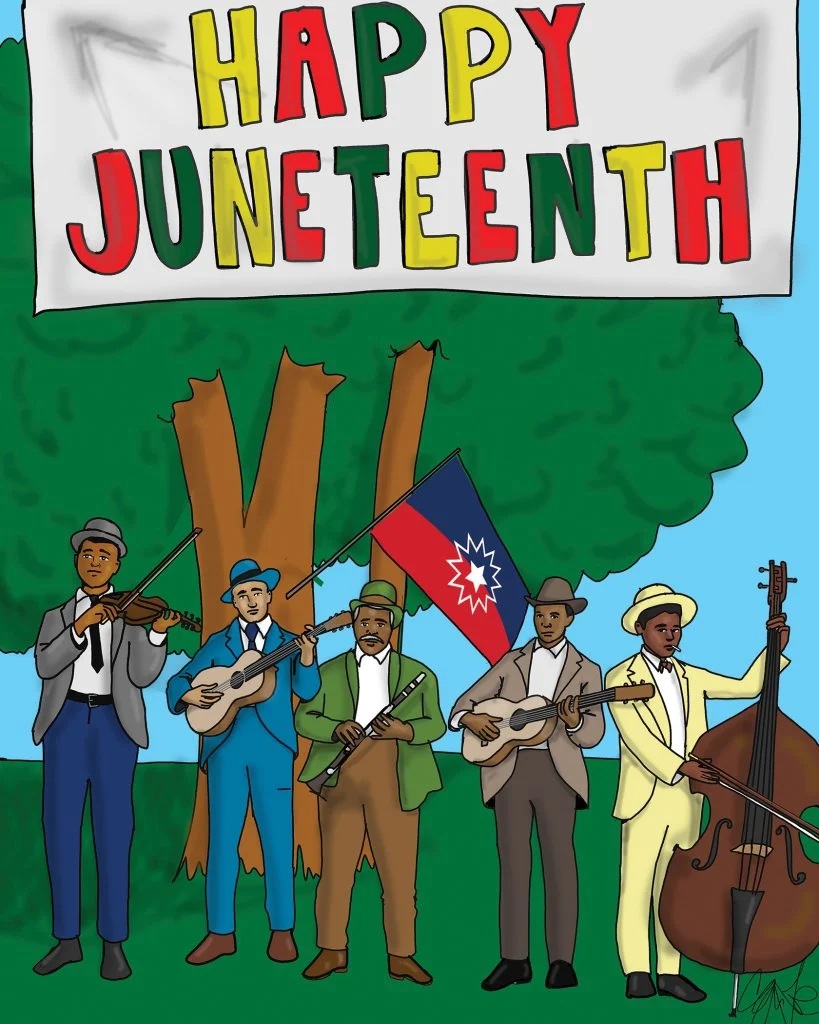
Honor the past, celebrate the present, shape the future. Happy Juneteenth!
Five years after the first time, the nation is celebrating Juneteenth as a national holiday. The annual commemoration of the liberation of the last Black slaves, in Texas, results from federal legislation that President Joe Biden signed in 2021. Since then, June 19, or the closest workday, has seen celebrations at public gatherings with Black people enjoying a summer feast and music, socializing all the while. Historically, Juneteenth has been more than that.
The newest federal holiday marks the June 19, 1865, order from Major General Gordon Granger of the Union army announcing the Civil War was over and declaring all enslaved people free. President Abraham Lincoln had issued the Emancipation Proclamation a year and a half earlier, covering the Confederate states, but not border states like Maryland and Delaware that sided with the North.
While some Southern slaves fled and made their way to Union army camps, the proclamation was not enforceable in Texas until Granger and his troops arrived in Galveston, Texas. Slavery was not formally abolished until the ratification of the 13th Amendment at the end of 1865.
The newly freed people of Texas celebrated for the first time what became known as Juneteenth the next year. The celebrations spread to other states in the Southwest and West. In 1980 Texas became the first state to make the day an official holiday.
Here in Boston, once Juneteenth became a federal holiday, it was combined with the annual Roxbury Homecoming in Franklin Park. This year’s is scheduled Saturday, June 20, sponsored by the Franklin Park Coalition. The event will follow the traditional format of a big picnic with barbeque galore, thumping music and throngs of people milling about and socializing. That is all good for maintaining and building a sense of community among the area’s Black residents.
Early celebrations of the practical end to slavery involved all that but offered something else as well. Traditionally, at least one noted speaker would hold forth on the state of Black folks, the progress since slavery ended and what more needed to be done to achieve full equality. Then the festivities would begin.
The absence of such a focus on milestones passed and still to be reached threatens to make Juneteenth a hollow holiday, akin to people who see Christmas as a time of gift-giving detached from the birth of Jesus and the religion he birthed.
Fortunately, there has been a smaller celebration in Boston that follows the traditional format. The Museum of the National Center of Afro-American Artists has long featured a keynote speech at its Juneteenth celebration on its spacious grounds in Roxbury. The 15th annual celebration, which obviously predates the federal holiday, is set for June 19. This year’s speakers are Tia Lites, former principal of the Helen Y. Davis Leadership Academy, once a public charter school in Dorchester; and Regie Gibson, poet laureate of Massachusetts.
The speechmaking tradition, though, has its challenges in this age of short attention spans. The late Charles Ogletree, the Harvard Law School professor, once gave a well-developed speech at the museum’s celebration, but not many people were actively listening.
To modernize the tradition, speakers might work in short videos, illustrative slides, music or all those media. How people communicate has evolved since the 1800s, and Juneteenth can keep up without losing its focus on the condition of Black folks.
So let the Juneteenth celebrations continue, incorporating and updating the speechmaking tradition that provided food for the mind to go along with the feast. There are many college professors and thought leaders in the Boston area who can be tapped to fill the role.
Ronald Mitchell
Editor and Publisher, Bay State Banner
Source: https://baystatebanner.com/2026/06/17/juneteenth-is-more-than-a-holiday-feast